
Tokenization Is Coming for the $126 Trillion Equity Market
The SEC fired the starting gun. Here’s what’s actually changing and what isn’t.

In 1792, two dozen brokers gathered under a buttonwood tree on Wall Street and agreed to trade only with each other. That handshake became the NYSE. The rules they set - fixed trading hours, centralized record-keeping, a clearing process for settlement have been refined over two centuries but never fundamentally rethought.
The SEC is reportedly preparing to release a framework that begins the rethinking. But what it’s releasing is stranger and more contested than the headlines suggest.
What the SEC is preparing to release
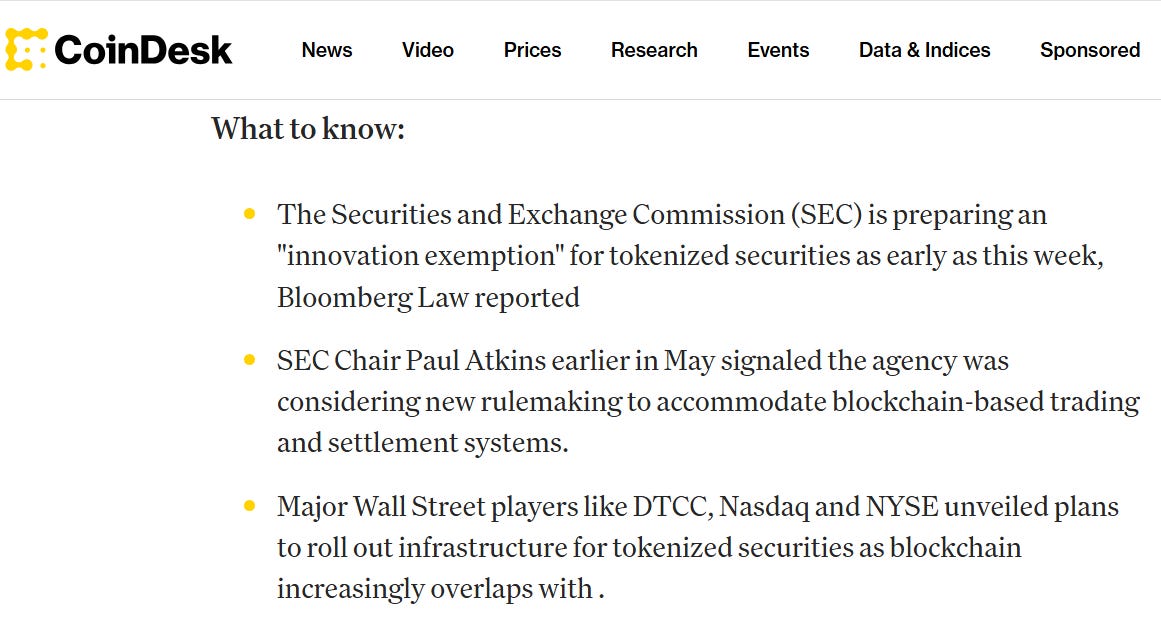
The “innovation exemption” is specifically targeted at crypto-native platforms like Coinbase, Kraken, and others - that currently lack full broker-dealer registration. Under existing rules, these platforms cannot legally offer US equity trading. The exemption creates a time-limited experimental window during which they can, subject to exposure limits and disclosure requirements, without going through the full registration process that traditional brokers require.
The more significant detail is who can create these tokens. The SEC is leaning toward permitting third-party tokenization - meaning a platform can create a token tied to Apple or Nvidia without those companies’ knowledge or consent. This is a deliberate policy choice. Coinbase filed a formal submission in April 2026 arguing that requiring issuer consent would contradict established securities law and create anticompetitive barriers. The SEC appears to have found that persuasive, at least for the experimental period.
The exemption is not permanent. Whether it leads to formal rulemaking and durable registration depends on what the experiment produces.
What’s already approved and confirmed
The exemption is the newest piece of a larger picture that’s already moving.
On March 18, 2026, the SEC approved Nasdaq’s rule change allowing Russell 1000 stocks and major ETFs to trade as blockchain tokens alongside traditional shares - same ticker, same CUSIP, same voting rights, same dividends. Full legal ownership. Nasdaq’s CEO confirmed December 6, 2026 as the target launch for 23/5 trading, with first tokenized trades possible by end of Q3 2026. NYSE received similar approval in April 2026. Both models are issuer-involved, rights-preserving, and operate inside the existing DTCC infrastructure an, upgrade to the regulated system, not a replacement of it.
What the innovation exemption adds is the crypto-native layer. It opens the door to platforms and participants that the Nasdaq/NYSE model, which requires working within traditional regulated infrastructure, doesn’t reach.
Third-party tokens are a different product
The term “tokenized stock” now covers instruments that are structurally different, and the difference is legal, not technical.
Nasdaq’s model gives full legal ownership. Token holders appear in the official shareholder record, receive dividends, vote at AGMs, and carry the same bankruptcy protections as any shareholder.
Kraken’s xStocks and Robinhood’s European stock tokens are custodial exposure - backed 1:1 by real shares held by a licensed custodian, but the token holder owns a claim against the custodian, not the share. Robinhood disclosed in a 2025 SEC filing that its tokens give customers exposure without conveying legal ownership or voting rights. If the custodian fails, the token holder is an unsecured creditor.
The third type is synthetic - tokens that track price with no underlying share custody, structured as derivatives. No ownership, no dividends, no voting.
The SEC is reportedly requiring qualifying tokens to provide dividends and voting access - platforms that don't would lose authorization. But third-party tokens created without issuer consent cannot legally pass through voting rights, since that requires the token holder to appear in the company's official shareholder record. How the SEC resolves that contradiction is the central unanswered question of the exemption.
Details are still being finalized, and some SEC officials remain opposed to third-party tokenization entirely.
Why anyone buys a token with no voting rights
The investors buying these products mostly don’t care about voting. The use case is DeFi composability - using equity price exposure within automated financial protocols.
Kraken’s xStocks FAQ is specific: deposit tokenized Tesla into a lending protocol and borrow against it without selling, add it to liquidity pools to earn fees, lend it to earn yield. Someone needing liquidity at 3am posts it as collateral and borrows stablecoins instantly - no bank, no wait.
That is the actual product. A 24/7, programmable, collateralizable price-exposure instrument, not a share. For that use case, voting rights are irrelevant. The investor protection concern is retail buyers who assume they own what they’d own through a broker. Robinhood and Kraken have both been explicit in disclosures. Whether that’s enough is a question regulators are actively asking.
What actually changes for markets
Every institutional participant today holds buffer capital to cover the 24-hour settlement gap. Near-instant settlement eliminates this. Freed capital gets redeployed, market makers tighten spreads, and the effect compounds across the market.
Price discovery improves when cash markets react to information as it lands. A result at 10pm currently sits untraded for up to 16 hours. Around-the-clock trading closes that gap in the cash market, not only through derivatives that most retail investors can’t access.
The clearest evidence for tokenization benefits comes from bonds, not equities. A 2023 Hong Kong Monetary Authority study found tokenized bonds had bid-ask spreads 5.3% lower than comparable conventional bonds, doubling to 10.8% for retail-accessible bonds. Congressional testimony in March 2026 ranked fixed income as the higher-priority asset class - existing equity markets already work efficiently, and fragmenting them carries real risk.
How tokenization plays out in India ?
SEBI, RBI, MCA, and FEMA have overlapping jurisdiction with no single authority holding a clear mandate. GIFT City is the only near-term sandbox.
When India adopts this, the impact is on the 4,900 companies below the Nifty 100 carrying a liquidity discount - institutions won’t size into illiquid names because exit is too difficult. That costs these companies hundreds of basis points in additional cost of capital. Tokenization expands the buyer pool and compresses that discount over time.
The corporate governance angle is underappreciated. If ownership records and the voting mechanism share the same infrastructure, an AGM vote costs the same effort as checking a notification. Retail participation in Indian AGMs today is negligible. In a market where promoter entrenchment is a genuine risk, that shift matters - slowly, but permanently.
Where this converges
The SEC’s January 2026 guidance was explicit: only issuer-sponsored tokenization can represent true equity ownership. The innovation exemption is a bridge while formal rulemaking catches up but the direction is already set. Synthetic and custodial tokens either meet that standard or move offshore.
The Nasdaq launch in Q4 2026 is the first real test of whether the full-ownership model works at scale. The exemption this week is the experiment running in parallel while the answer becomes clear.
CompoundingAI is a vertical intelligence engine that transforms unstructured documents into decision-grade insights, complete with source-level traceability for confident, auditable workflows.
We cut the noise & directly deliver insights.